
Nr.1 TOURIST ATTRACTION
Amsterdam Museum, 31 October 2019 – 1 March 2020
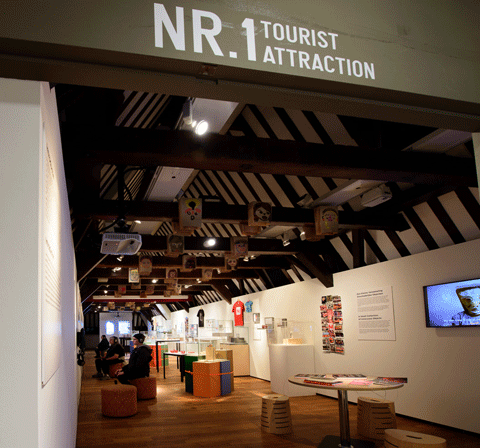
Nr. 1 Tourist Attraction was produced for the seventh annual collaboration between CBK Southeast and the Amsterdam Museum, whereby a contemporary Amsterdam artist is invited to reflect on the city through their work. During my month-long BijlmAIR residency in Amsterdam Southeast I was to investigate connections between immigration, trafficking and prostitution with the aim of producing new videos for my on-going series The Prostitution Monologues which would form a central part of the installation in the Amsterdam Museum. The exhibition focussed on the topic of prostitution in general, and the Dutch sex industry and Amsterdam Red Light District in particular, and it turned me into a target for the wrath of the pro-sex-work lobby.
As an artist I find it essential that my work engages with important social themes, and I aim to use my work as a reflective tool for unravelling issues relating to social injustice, inequalities, and the underlying structures supporting the assignment of power in relation to class, race and gender. In recent years, the issue of prostitution has formed a substantial part of my artistic research. The topic is one which is close to me, both from my position as a woman, as well as in terms of location. As an inhabitant of Amsterdam this issue is one I felt compelled to investigate with my work. 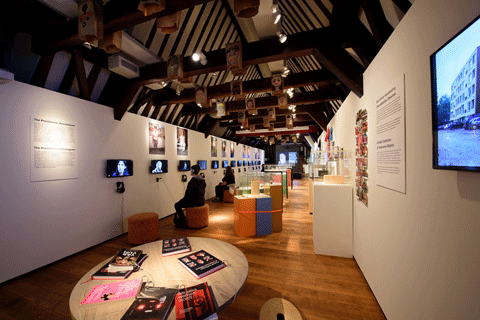
Amsterdam is viewed by the world as symbolic of a culture of liberal values, everything-goes-tolerance, and an abundance of laissez-faire attitudes to drugs and sexuality. The Netherlands has taken on the role of a torchbearer for liberalised prostitution regulations, and presents Dutch legislation to the rest of the world as a success story. That image continues to be cultivated and promoted by the city – after all, the sex industry provides a huge financial turnover. Belief in current prostitution policy as a successful solution persists among the Dutch, with many people preferring to believe the myth that the majority of women are selling sex freely and autonomously, rather than think deeply about the realities of the lives of women in situations of prostitution. 
The Prostitution Monologues, an ongoing video series that details the stories of women’s journeys into prostitution, formed an important part of the installation. Each of the testimonies in these videos is based on texts taken verbatim from interviews conducted personally with people in prostitution. The videos are concerned with the circumstances that have led women into selling sex (rather than the gruesome details of encounters behind closed doors). My connection with the women concerned (the overwhelming majority of people in prostitution is female) is the result of long term research and investment. (I worked for some years as a volunteer ‘crisis-buddy’ at an Amsterdam hostel for women who have been trafficked, predominantly into the sex-industry.) 
Many of the women have come from sub-Saharan Africa or from the ex-communist, east-bloc countries, and their individual tales reveal backgrounds in societies rife with inequalities, misogyny and abuse, and expose the painful, disturbing reality of racial and class privilege, along with a tenacious assumption of male entitlement. Their histories are witness to the way in which prostitution and sexual exploitation are tied to larger economic and political processes, such as economic imbalance, privatisation and corruption. Precisely from their position at once in the margin and in the centre of society, these women’s stories are able to shed light on the larger links which are often ignored in the debate concerning prostitution.
In the videos, scripts based on the testimonies are performed by actors who read the story in the first person, whilst not attempting to cover up the fact that they are an actor telling someone else’s story. The actors are filmed using a deliberate simplicity, switching between classic, talking-head, and extreme close-up displaying the pores and imperfections and emphasising the vulnerability of the flesh. I intentionally use actors who are clearly dissimilar – in terms of gender, nationality, race – to the protagonist whose story they are relating. This aims to produce an estranging effect which disturbs the viewers’ conceptions and challenges a general ‘out-of-sight-out-of-mind’ response to such stories, whereby such things might seem to be circumstantially inevitable when they happen to a young woman from Sierra Leone, and yet not when it is a white, English-speaking man relating the tale. 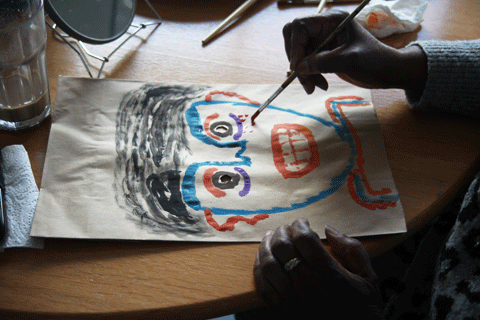
Twenty video monologues were shown as part of Nr.1 Tourist Attraction: women trafficked from West Africa into the Dutch sex industry; women who had worked in the windows of the Amsterdam Red Light District; and from other countries where I have been able to collaborate with survivors – including Argentina, Senegal, Albania. This multiplicity is important, because, although is unusual that a visitor watches all the stories, the multiple screens convey the sense that this is something that goes on and on, and on… Also, the proximity of the adjacent screens, and the way their subtitles perhaps reflect on the narrative you are following, can add to the sense that it is something that is happening unremittingly. The actor in one video may be relating their escape, but their neighbour is still being violently raped and beaten. 
The circumstances of these prostituted women (and just one man) require that they remain anonymous, so each of them has painted their own self-portrait on a paper-bag in order that it could then be worn as a mask. These self-portraits serve both to retain the women’s anonymity whilst at the same time being an expression of how they see themselves. The masks are hung high to look down on their audience, seeming to demand a sense of almost judicial propriety in the face of the experiences embodied in them. 
A Small Collection of Innocuous Objects, faced the wall of videos, running the length of the space, a myriad of colourful mismatched display cases containing artefacts, over 200 tourist souvenirs promoting the Amsterdam Red Light District. Half of these are fridge magnets – the epitome of banal domesticity, helping to instil the idea that paid sex is as innocuous as a kitchen sink, homely and inoffensive. And there are snow globes containing women in windows, porcelain houses filled with smiling scantily clad women, lapel pins, calendars, t-shirts, a salt and pepper set, and racks of postcards… in Amsterdam, on display alongside windmills, tulips, canals clogs, cows and bicycles, postcards of women in fancy, glowing underwear posing in red-lit windows, their individuality pixillated away, are omnipresent. 
These objects underline Dutch complicity with the myths promoted by the sex industry, and show how the haze of commonplace imagery pertaining to prostitution permeates our day-to-day lives. Imagery that promotes and reinforces the view of the prostituted woman as autonomous and liberated, whilst preventing us from seeing the very real pain and distress that exist behind this superficial, one-sided vision. 
These souvenirs are accompanied by descriptive and critically analytic texts which deconstruct and analyse each artefact in detail, examining its message, linking it to related historical facts or statistics, thus enabling the ‘propaganda’ of the subliminal message to be subverted. This close examination of the jolly imagery of idealized, willing ‘happy hookers’ and the conspicuous misogyny presented on these souvenirs, contrasts sharply with the haze of subtle ‘propaganda’ concerning prostitution that permeates our day-to-day lives encouraging the acceptation of paying for sex as an inevitable, necessary, and even desirable, form of harmless ‘entertainment’.
By placing these souvenirs in display cases as artefacts, labelled and displayed like an anthropological collection – similar to the supposedly ‘curious’ and ‘savage’ customs of historic ‘uncivilised’ societies that we are accustomed to seeing displayed in such a fashion – one could imagine them relegated to the past, and perhaps envisage a future in which have moved beyond an acceptance of this outmoded, barbaric ‘tradition’. And by juxtaposing these ‘innocuous objects’ against the stories which show a world where the maltreatment, abuse and subjugation of women endures, a space is created where viewers can reflect for themselves on the issue of prostitution and how the predominant imagery may have influenced their views. 
The publication A Small Collection of Innocuous Objects accompanies the installation. It shows a large number of souvenirs with their critical texts, and a selection of testimonies from people prostituted in the Netherlands. You can see more of the book by clicking HERE:

Also contained in the book is a series of photographs from another work entitled Belle Revisited. It is a work that was inspired by a small bronze statue in the heart of the Red Light District in Amsterdam. The statue, beside which tourists pose to have their photograph taken, stands on a stone plinth with a brass plaque declaring ‘Respect sex workers all over the world’. It was conceived by Mariska Majoor, a self-professed, former sex worker, who founded the Prostitute Information Centre (PIC) in Amsterdam.

The aims behind the statue’s conception appear noble (we can all agree that stigma toward people in situations of prostitution is a bad thing), yet the statue made me extremely uncomfortable, and on the one hand, I can understand that when you are coming from a situation where you are the subject of abuse and stigma and feel looked down upon, a statue such as Belle, a woman honoured by her placement on a plinth in a public square, standing strong, unaffected by stigma, impervious to abuse, could provide a sense of worth, a smidgen of hope that perhaps someday the stigma will subside and you too will be able to stand uncowed and smiling. But on the other hand, I felt strongly that reinforcing the ‘happy hooker’ aspect of the trade, negating the abuse and violence we all know occurs behind the enforced smile, the appearance of willingness essential to procuring buyers, is doing women in prostitution a huge disservice. By emphasising that façade, the overwhelming presence of violence, which is a huge reality in these women’s lives, is being negated. Possibly it burdens them yet again with the requirement that they conform to the myth that they are happy and willing, this time in order to participate in the narrative which is being presented here so publicly, through this statue, ostensibly in their name. 
My work Belle Revisited is a life-sized wooden figure, carved from an enormous tree trunk which was central to a performative ritual in which I invited people to carve their initials and a heart into the sculpture’s wooden torso as a symbolic representation of society’s complicity in turning away from the very real damage being done to women within the actual doorways of the world’s red light districts – an experience which for some was extremely moving – several of the participants were in tears as they stepped away from the sculpture having carved their initials. The resulting accumulation of carved initials becoming indicative of the extent of the trade in women’s bodies. The photographs in the book show initials being carved into the treetrunk-sculpture.
Especially for Nr. 1 Tourist Attraction I set out to stage the initials-carving a second time and to create a video of it. The video-loop, Zandpad Revisited, shows an onslaught of men and women wielding sharp implements, carving their initials into the wood. Shot with a handheld steady-cam, the images are in continuous motion, whilst the figure remains impassive, unmoving. The light fades, and returns, the attack continues, the fluid images contrasting with the sharp, crass noises of the chisels and knives cutting their initials, over and over and over again. The title of the work refers to the location where this video was shot, and was chosen for its contextual importance. The ‘old’ Zandpad, had been the location of a number of Red Light houseboats which were used for window prostitution in Utrecht, but in 2013 the city was compelled to close the site due to extreme ongoing violence and exploitation. The sex industry, however, campaigned to have it re-opened, and consequently a patch of land has now been designated for the building of a series of new ‘windows’. Construction on the new site is meanwhile delayed as the companies interested in ‘managing’ the new brothels failed to pass laws pertaining to connections with unlawful practices such as drugs or money laundering, and exploitation. It is on this contentious building site that I recorded the video loop Zandpad Revisited. 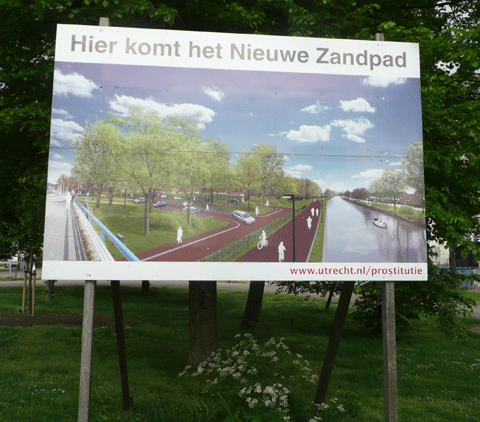
The video was due to be shown at the Amsterdam Museum along with the sculpture itself but one week before the installation was due to open, pro-sex-work lobbyists launched a full scale attack on the museum, the exhibition and me personally. They had realised that the upcoming installation was being made by an artist who was anything but positive about prostitution and they attempted to shut down the exhibition before it had even opened, attacking the museum where it hurt most, claiming that it went against their policy of inclusiveness, and even staging a demonstration outside the museum with placards with texts such as, ‘Amsterdam Museum curates propaganda’ and ‘Listen to Sex Workers – Close Nr.1 Tourist Attraction expo!’
The Prostitution Information Centre (PIC) sent two-page letters to the museum, to arts funding organisations, and to all the major newspapers. The bulk of the letter was aimed specifically at the ‘Belle’ sculpture and video, claiming that the works were an incitement to violence against sex workers and even citing one of the PIC team members as saying, “An exhibit like this makes me fear for my physical safety. If people are encouraged to carve into a wooden statue of an independent sex worker, why wouldn’t they think it’s ok to harm one in real life?” This is an obvious piece of nonsense. The intention of the work was the exact opposite of what they were claiming. 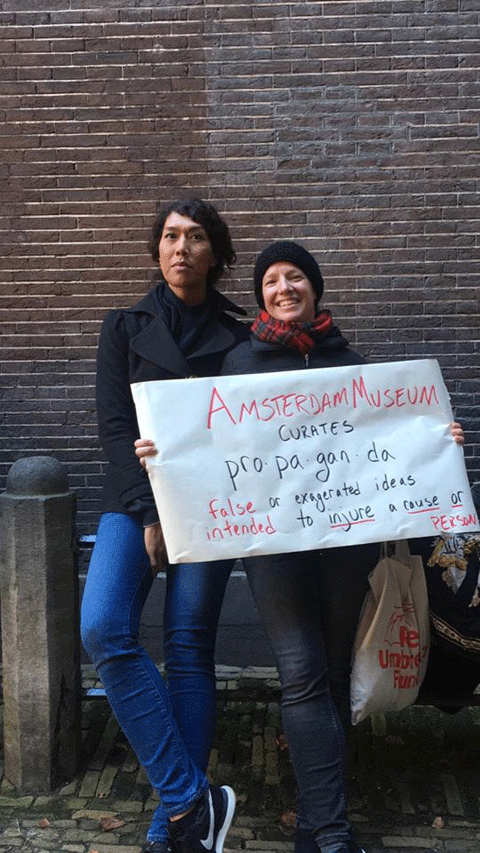
Following lengthy discussion with the Museum, it was decided to open the exhibition without those two works. It was important to me that their presence not be used by the sex-industry as a way to sidetrack discussion into an ‘Oh-yes-it-is-Oh-no-it-isn’t’ argument about whether the sculpture and video incite violence or not, as that would distract from any broader debate on the topic of prostitution – which is what I hoped the exhibition would encourage. 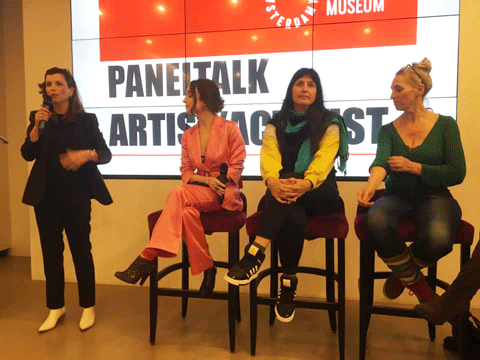
Despite the negative reactions from the pro-sex-work lobby – the unanticipated ferocity and abusiveness of their attacks; the (willful?) misinterpretation of the statue and the video – the response of the majority of the public who came to the exhibition was encouraging. Whenever I dropped by the exhibition, talking to visitors, finding out their views and how the installation has affected them, I also made a point of reading the comments in the visitors book. There I found the things that ordinary visitors to the museum had taken the time to write and I feel it has been extremely worthwhile…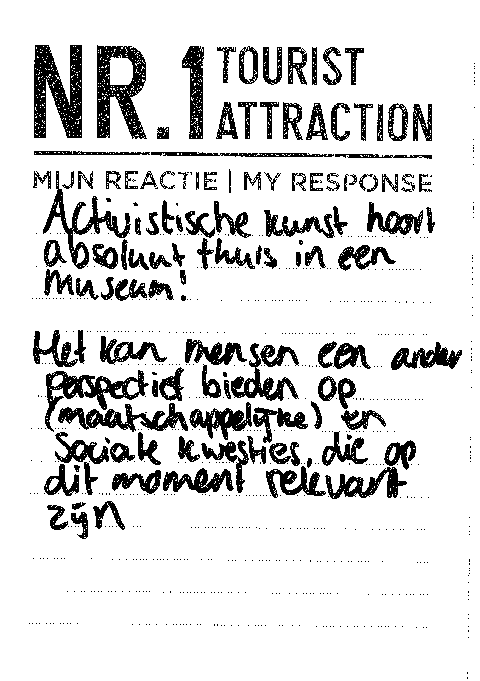
“This exhibition and artist reveal that nothing is what it seems to be.
She provides a platform for sex workers to unmask the Red Light District and tell their side of the story. It’s very important to look beyond the lights.”
.
“Respect for the Amsterdam Museum and admiration for the artist! This exhibition highlights a side of the sex industry that is overshadowed in the Netherlands by a small club of “happy sex workers” who keep emphasizing that there’s nothing going on in the prostitution world. Jimini allows the voices women who have not been heard for a long time to be heard. It is time that we finally listen!”
.
“Thank you for being brave enough to tell the real stories of what goes on.
Wonderful eye-opening exhib.”
.
“Well done museum. Human trafficking and sex slavery is real. In the Netherlands there are thousands of victims forgotten by the public, shamed by pimps and ridiculed by other sexworkers. These victims need the spotlight, need help. Well done for the exposé. You will get buckets full of shit thrown at you but you are doing the right thing. Stop the abuse, the rape, the slavery!” 